
Sell Your Glasgow City-Centre Property Directly
Tenement in Garnethill, apartment in Merchant City, flat in Cowcaddens or Blythswood Hill? We buy city-centre properties off-market — no agent fees, no chain, no pressure.
A private, direct sale — clear communication from first call to completion.
Areas and Property Types We Consider
City-centre flats in Glasgow rarely fit a standard sale. The table below reflects the types of property typically found in each neighbourhood and common sale considerations — based on observable building stock, not invented transaction data.
| Neighbourhood | Typical property types | Common sale considerations |
|---|---|---|
| Merchant City | Converted Georgian/Victorian warehouse apartments; modern flatted developments | Factoring agreements; historic building fabric; converted commercial title conditions |
| Garnethill | Traditional blonde sandstone tenement flats; Mackintosh-era buildings | Shared roof and close liability; older wiring and heating systems; factor or self-factor arrangements |
| Blythswood Hill | High-specification city-centre apartments; some converted office buildings | Service charges and residents' management companies; fire-safety documentation requirements |
| Cowcaddens | Modern apartment complexes with concierge; some tenement conversions | High-rise and medium-rise fire-safety assessments; higher proportion of investor-owned stock |
| Townhead | Ex-council mid-century flats; 8-in-a-block and deck-access blocks | Non-traditional construction; mortgage-lender restrictions; student lettings overlap |
| Anderston / Charing Cross | Mixed modern and sandstone conversion flats | Proximity to transport; higher proportion of investor-owned stock |
| City Centre core (G1/G2) | New-build flatted developments; hotel and serviced-apartment conversions | Planning and licensing conditions; short-term let licence status |
We also consider properties in Finnieston, Laurieston, Gorbals and immediately adjacent areas where a complication suits a direct buyer. Not sure? Get in touch and we will advise.
Common City-Centre Sale Complications
Open-market sales of Glasgow city-centre flats can be held up by issues that are common across the building stock but unfamiliar to mainstream mortgage buyers. Understanding them in advance helps you choose the right sale route.
Factors, Common Repairs and Title Conditions
Most tenement and flatted buildings in Glasgow are managed by a property factor — a registered company responsible for shared areas such as the roof, stairwell, external walls, and communal garden. All property factors in Scotland must be registered with the Scottish Government under the Property Factors (Scotland) Act 2011 and follow a published Code of Conduct.
When you sell, your solicitor will need to confirm:
Outstanding factoring debt
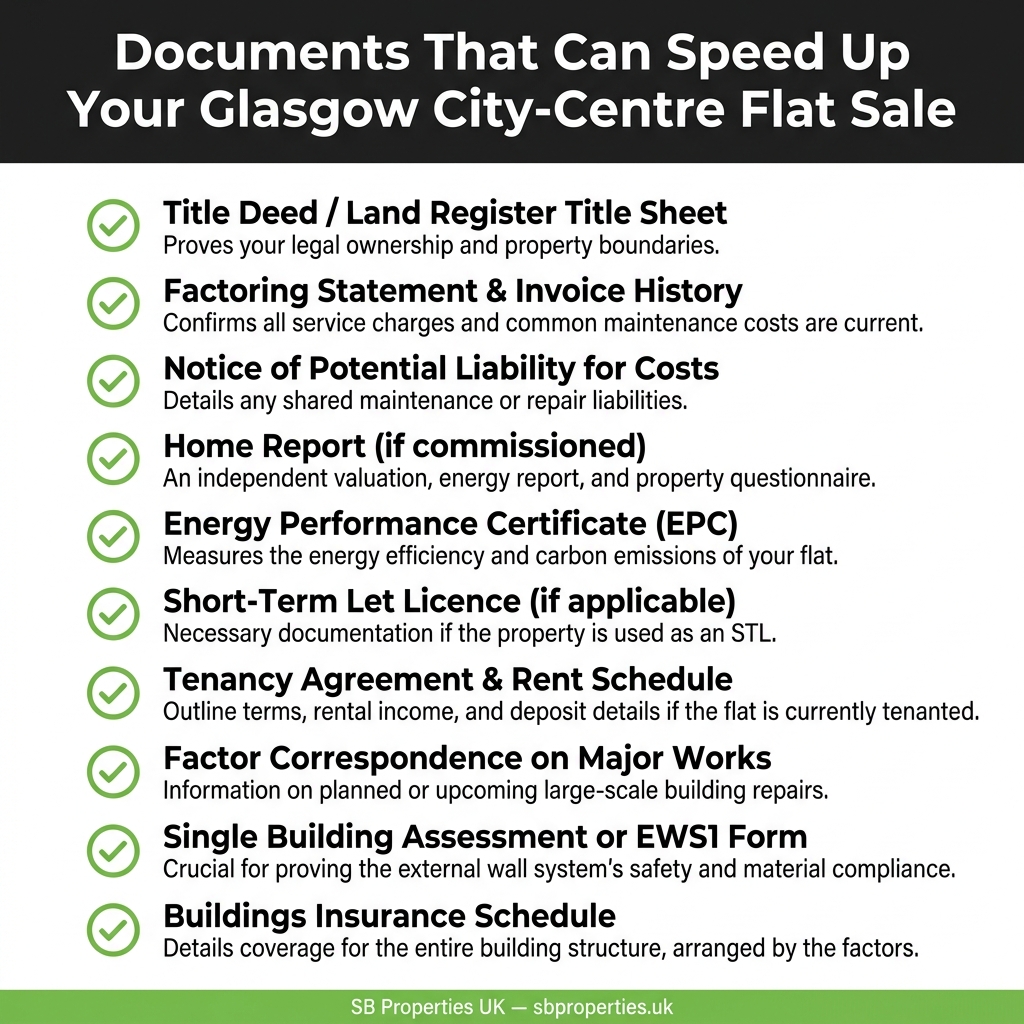
Unpaid common-repair invoices can register as a Notice of Potential Liability for Costs against your title on the Land Register of Scotland. This must be resolved or retained before missives conclude.
Proposed major works
If your factor has issued notice of significant upcoming works — re-roofing, close rendering, lift replacement — buyers and lenders will want to understand your share of the cost.
Title deed conditions
Your title deeds may contain real burdens specifying how repair costs are apportioned. The Tenements (Scotland) Act 2004 Tenement Management Scheme applies as default where title deeds are silent.
Notice of potential liability
Other owners or your factor can register this publicly against your property. A direct buyer can assess this as part of the offer rather than causing a sale to fall through at a late stage.
Tenants, Short Lets and Vacant Properties
Tenanted properties. If your flat is let on a Private Residential Tenancy (PRT) under the Private Housing (Tenancies) (Scotland) Act 2016, your tenant has significant security of tenure. You cannot end the tenancy simply because you wish to sell. To recover possession for a sale, you must serve a valid Notice to Leave citing the intention-to-sell ground, observe the correct notice period (28 days for tenancies under six months; 84 days for six months or more), and — if the tenant does not vacate — apply to the First-tier Tribunal for Scotland for an eviction order. Alternatively, the property can be sold with the tenant in situ — the new owner simply becomes the landlord. See our tenanted property service page for a full explanation.
Short-term let properties. If your flat has been operated as a short-term let, it must hold a valid Short-Term Let Licence issued by Glasgow City Council and may require a separate change-of-use planning consent — particularly for secondary letting in blocks with communal entrances. Operating without a licence is a criminal offence. When selling, you must disclose the licensing and planning position; if the licence is non-transferable or consent is absent, this can significantly restrict your open-market buyer pool.
Vacant or unoccupied properties. Properties that have been empty for a period may accumulate council tax liability and could have been affected by condensation, damp ingress, or vandalism. We consider properties in this situation. See our guide on selling a property in poor condition in Scotland.
Condition, Lending and Cladding Documentation
Condition and mortgage lenders. Many Glasgow city-centre flats present condition categories that mainstream lenders treat with caution. A Home Report Single Survey may flag Category 2 or Category 3 repairs — which can restrict the field of mortgaged buyers. A direct cash purchase sidesteps the lender stage entirely; condition is factored into the figure we put forward rather than creating a dead end.
Cladding and fire-safety documentation. If your property is in a flatted building of 11 metres or more in height, constructed or refurbished between 1 June 1992 and 1 June 2022, it may fall within the scope of the Housing (Cladding Remediation) (Scotland) Act 2024, which came into force in January 2025. Scotland's primary fire-safety evaluation tool is now the Single Building Assessment (SBA); the EWS1 form remains a non-statutory process whose applicability depends on individual lending policy. If your building has no SBA and a buyer's lender requires one, a conventional mortgaged sale may stall until the assessment is complete. A direct sale does not require lender sign-off on fire-safety documentation, which is a material practical difference.
Why consider a direct sale?
No mortgage approvals, no risk of a buyer pulling out at the last stage.
Factors, cladding issues, tenants and poor condition all assessed.
You instruct your own solicitor; no marketing or listing fees from us.
Private sales may not require one — read our guide.
One figure, explained. Not subject to last-minute gazundering without good cause.
No pressure. You remain free to use an estate agent or auctioneer.
The information on this page is general guidance only — it is not legal, financial or surveying advice. For advice specific to your situation, speak to your own Scottish solicitor or an independent financial adviser.
How the Offer Is Assessed
We do not use an automated valuation model to generate a number. When you contact us about a Glasgow city-centre property, our assessment follows three clear steps.
Market data review
We review publicly available comparable transactions for similar flats in your postcode and building type, drawing on Land Register records and current listings.
Property-specific factors
Condition as described, tenure, factoring and repair position, tenancy status, cladding documentation, and any title conditions that affect saleability or value to a mainstream buyer.
Considered direct offer
We arrive at a figure that reflects the speed and certainty of a direct sale alongside any discount that the property's condition or complication warrants.
Your decision, no pressure
You are under no obligation to accept. Test the open market, speak to an auctioneer, or take independent advice first — we encourage it. Compare the costs here.
The figure we put to you is a direct cash offer — not a valuation. It is not a RICS valuation and should not be treated as one. This page does not constitute a formal valuation, mortgage valuation, or financial advice. Sellers should obtain independent legal advice from a Scottish solicitor before committing to any sale route.
Direct Sale vs Open Market vs Auction
Each route has genuine advantages and real trade-offs. The table below summarises them honestly for a city-centre Glasgow flat. No single route is right for every seller. For investment property owners, our blog on selling a rental property in Glasgow explores tax and timing considerations in more depth.

| Factor | Direct sale (SB Properties UK) | Open market (estate agent) | Auction |
|---|---|---|---|
| Timescale | Typically 4–8 weeks from offer to completion, subject to legal process | 6–8 weeks once a buyer is found; marketing period is variable | Legally binding on fall of hammer; completion usually within 28 days |
| Sale certainty | High — no chain, no mortgage approval required | Lower — fall-throughs occur; chains can collapse | High once hammer falls; property may not sell if reserve is not met |
| Price achieved | Reflects speed and certainty; will be below top market value | Potential to achieve full market value at a competitive closing date | Variable; competitive bidding can produce strong results or disappoint |
| Complications | Cladding, condition, tenants, factoring issues all considered | Complications restrict buyer pool and can cause delays or abortive costs | Disclosed in legal pack; specialist auction buyers accept complications |
| Costs | No agent commission; you instruct and pay your own solicitor | Agent commission (typically 1–2% + VAT) plus Home Report cost | Auctioneer commission (typically 2–3% + VAT) plus legal pack and Home Report costs |
| Home Report | Not required for a private sale — see our guide for the precise legal position | Required by law before marketing on the open market | Required; must be commissioned as part of the auction legal pack |
Timescale and cost ranges are general estimates based on typical Scottish transaction patterns and publicly available solicitor guidance. They are not guarantees.
Process and Realistic Timescales
A direct sale to SB Properties UK follows Scottish conveyancing law. Once missives are concluded, the contract is legally binding and neither party can withdraw without consequence. Here is what a typical transaction looks like.
Initial conversation
You contact us and describe the property and your situation. No commitment required and no charge for the conversation.
Property review & offer
We review available data and may arrange an inspection. We set out a written figure and the basis on which it is made. Accept, decline, or take time — your choice entirely.
Solicitors and missives
You appoint your own independent Scottish solicitor. Solicitors on both sides exchange formal missives and investigate title, factoring position, and any outstanding matters.
Completion (Date of Entry)
Funds transfer and title passes on the agreed date. Four to eight weeks is achievable for a clear title; properties with factoring or cladding complications will take longer.
We will tell you honestly at the outset if we foresee a likely delay. We do not promise completion by a fixed date — conveyancing timescales depend on solicitor capacity, title investigation results, and circumstances outside any party's full control.
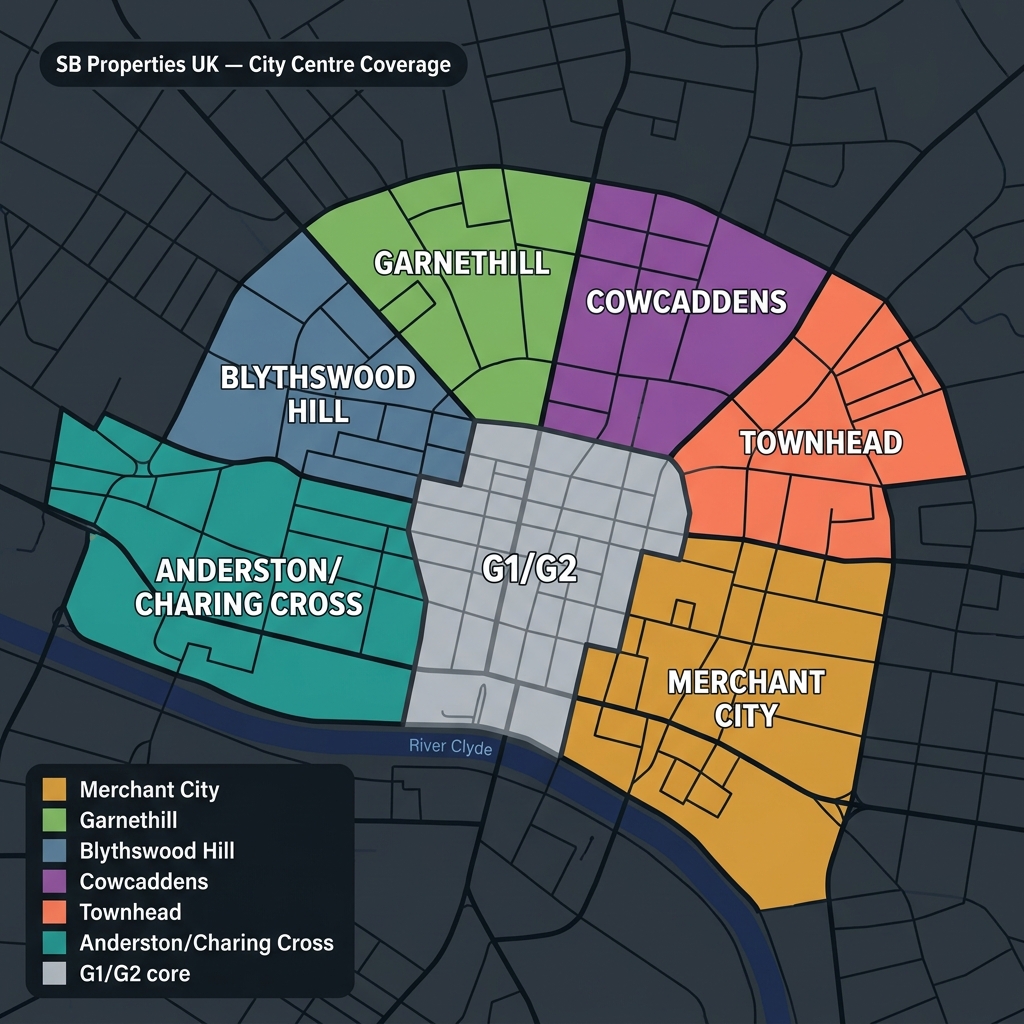
City-Centre Neighbourhoods We Cover
Not sure if your street is included? Get in touch and we will advise you directly.
FAQs
Questions we hear regularly from Glasgow city-centre flat owners considering a direct sale.
Do you buy tenement flats in Glasgow city centre?
Yes. Traditional sandstone tenement flats — including those in Garnethill, Blythswood Hill, and across the G1, G2 and G3 postcodes — are among the most common properties we consider. We are familiar with the factoring arrangements, common-repair structures and title conditions typical of Glasgow tenements.
Will you still make an offer if the building has no EWS1 or Single Building Assessment?
We can consider properties where fire-safety documentation is absent or incomplete. We will want to understand whether the building falls within the scope of the Scottish Government's Cladding Remediation Programme and whether an SBA has been requested. A direct sale does not require a lender to approve the building's fire-safety status — a significant practical difference from an open-market sale.
Does my property need a Home Report?
Under the Housing (Scotland) Act 2006, a Home Report is legally required when a property is marketed for sale to the public. A sale agreed directly and privately with a buyer before any public marketing does not trigger this requirement. If you already have a Home Report it can be useful supporting information. Read our full guide to selling without a Home Report in Scotland for the precise legal position.
Can you buy my flat if I have tenants?
Yes. We consider tenanted properties. The tenancy must be handled in accordance with the Private Housing (Tenancies) (Scotland) Act 2016. We can purchase with the tenant in situ — the new owner simply becomes the landlord on the same terms — or, in some circumstances, wait for the tenancy to end through the correct legal process. See our tenanted property service page for more detail.
How do you calculate the offer on a city-centre flat?
We look at comparable Land Register market data, the property's condition and title position, the cost and time saved by a direct sale, and any specific complication affecting value or saleability. The figure is arrived at by a person who has reviewed your property's specifics — not an automated tool. It will be below full open-market value; that is the trade-off for speed, certainty and reduced cost. It will be clearly explained and not subject to last-minute revision without good cause.
What fees do you charge?
We do not charge you commission or a marketing fee. You will need to instruct and pay your own solicitor for conveyancing — we recommend doing this independently. If there are any other costs relevant to your specific transaction, we will explain them before you commit to anything.
Is the information on this page legal or financial advice?
No. Everything on this page is general guidance for illustrative purposes only. It is not legal, financial or surveying advice. You should take independent advice from a Scottish solicitor, financial adviser, or RICS-qualified surveyor before making any decision about your property. mygov.scot provides a good overview of the Scottish buying and selling process.
Related Pages
Request a Confidential Property Review
If you own a city-centre flat or investment property in Glasgow and would like a direct, no-obligation assessment, share your details and we will be in touch. We will not pressure you, pass your details to agents or third parties, or make any claim on your time unless it is genuinely useful to you.
You are free to use an estate agent, auction house, solicitor-led sale, or any other route. If the direct route suits your circumstances, we are here to discuss it straightforwardly.
Email:
info@sbproperties.uk
Phone:
07346739722
Service Area:
Glasgow City Centre · G1 · G2 · G3 · Central Scotland
Speak to Us About a City-Centre Flat
Share your details and we will confirm a convenient time to speak. Your information is handled privately and not shared with third parties.